
Blue Mosque FAQ: Every Visitor Question Answered
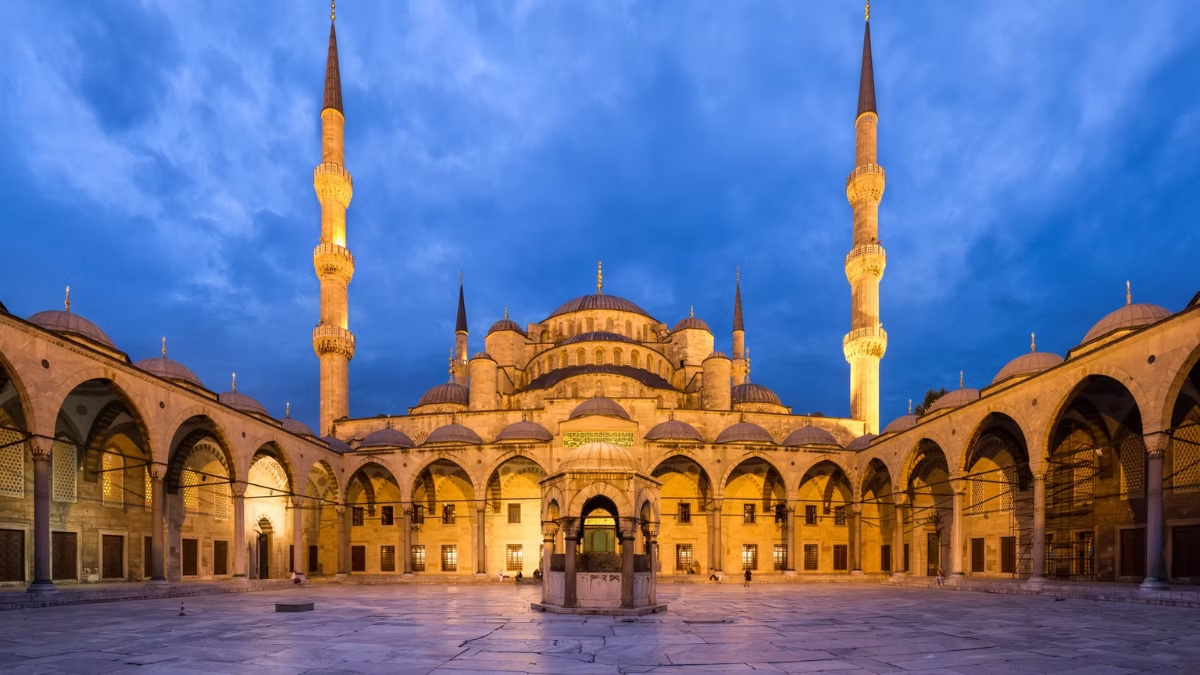
The Blue Mosque is free to enter, open daily except during the five daily prayer times, and requires covered shoulders and knees for all visitors plus a headscarf for women. No booking is needed. The main practical considerations are timing your visit around prayer closures and arriving already dressed to minimise delays at the entrance.
This page compiles the questions visitors ask most frequently before and during a visit to the Blue Mosque. Each question links to the relevant full guide on this site for anyone who wants more detail.
Entry, Tickets & Booking
Is the Blue Mosque free to enter?
Yes. Entry to the Blue Mosque is completely free for all visitors, regardless of nationality or religion. There is no ticket, no booking system, and no reservation requirement. You walk in, pass a security check, and enter. Donations are accepted at the exit but are entirely voluntary. Full details in our entry tickets guide.
Do I need to book tickets for the Blue Mosque in advance?
No. There is nothing to book. The Blue Mosque has free, open public access during visiting hours. Simply arrive at the tourist entrance on the south side of the mosque (facing Hagia Sophia), pass security, comply with the dress code, and enter.
Is the Istanbul Museum Pass valid at the Blue Mosque?
No. The Istanbul Museum Pass (Müzekart) is not valid at the Blue Mosque because it is an active mosque with free public entry, not a paid-entry museum. The Museum Pass covers Topkapi Palace, certain Ottoman mansions, and other paid-entry state cultural sites.
Do I need a guided tour to visit the Blue Mosque?
No. The mosque is entirely accessible as a self-guided visit. Guided tours add historical and architectural context that significantly enriches the experience, but they are optional. See our guided tour review and private vs. group tours guide for when a tour is worth the cost.
Are there different entrance fees for adults and children?
No. Entry is free for everyone — adults, children, and infants. There are no age-based admission charges of any kind.
Opening Hours & Prayer Times
What are the Blue Mosque opening hours?
The Blue Mosque is open to visitors from approximately 08:30 until one hour before dusk (approximately 18:30 in summer, 16:30 in winter). It closes to non-Muslim visitors during the five daily prayer times, each lasting approximately 90 minutes. On Fridays, it is closed until approximately 14:30 due to the extended Friday noon prayer (Jumu’ah). Full opening hours and the prayer time schedule are in our opening hours guide.
How long are the prayer closures?
Each prayer closure lasts approximately 90 minutes. Five prayers occur daily — Fajr (dawn), Dhuhr (midday), Asr (afternoon), Maghrib (sunset), and Isha (night). The midday Dhuhr closure, typically 13:00–14:30, and the Friday Jumu’ah closure (which extends from approximately 12:30 until 14:30) are the closures most likely to affect a daytime visit.
Can I visit the Blue Mosque during prayer times?
No. The mosque is closed to non-Muslim tourists during the five daily prayer times. Worshippers continue to use the mosque. You can wait in the courtyard during a closure — the courtyard, mausoleum, and Arasta Bazaar all remain accessible.
Is the Blue Mosque open on Fridays?
Yes, but with an extended closure. The mosque closes to tourists from approximately 12:30 until 14:30 on Fridays for the Jumu’ah (Friday noon prayer). It is open to tourists before and after this window. Fridays are generally the most crowded visiting days as tourists surge in after the 14:30 reopening.
Is the Blue Mosque open on public holidays?
Yes. The mosque operates on its standard schedule on Turkish public holidays. During major Islamic festivals (Eid al-Fitr, Eid al-Adha), prayer schedules shift and the mosque may be busier than usual.
Dress Code
What is the dress code for the Blue Mosque?
All visitors must cover their shoulders and knees. Women must also cover their hair. Shoes must be removed before entering the prayer hall. Tight-fitting or transparent clothing is not acceptable even if it technically covers the required areas. Full details and specific guidance on what to wear in our dress code guide.
Are free scarves available at the entrance?
Yes. Free scarves and robes are available at the tourist entrance for visitors who do not arrive appropriately dressed. These are provided at no charge. However, during busy periods the clothing stand may itself have a short queue — arriving already dressed is faster and more comfortable.
Do men need to cover their heads?
No. Head covering is required only for women inside the mosque. Men need only cover their shoulders and knees.
Can I wear shorts to the Blue Mosque?
Shorts are not permitted. Knees must be covered for all visitors, men and women. If you arrive in shorts, free body cover garments are available at the entrance, though the stand can have a short queue during peak times.
Is the dress code enforced?
Yes. Staff at the entrance check clothing before admitting visitors. Visitors who are not dressed appropriately will be redirected to the clothing stand before they can proceed.
The Queue & Security
How long is the wait at the Blue Mosque?
The wait is the mandatory security check — a bag X-ray and metal detector. At opening (08:30) and at quiet weekday periods, this takes 5–10 minutes. During peak season (June–August) between 10:00 and 14:00, waits can reach 60 minutes. See our skip the line guide for timing strategies.
Is there a skip-the-line ticket for the Blue Mosque?
No. Entry is free, so there is no ticket queue to bypass. The only queue is the mandatory security check, which cannot be skipped with any ticket. The most effective ways to minimise the wait are arriving at 08:30 on a weekday, or visiting in the late afternoon after the Asr prayer closure ends.
Can I bring a large bag or suitcase into the Blue Mosque?
No. Large bags and suitcases are not permitted. Small day bags pass through the X-ray check. If you are carrying significant luggage, store it before visiting — there is no luggage storage at the mosque itself. Nearby hotels, the Arasta Bazaar, or left luggage services along Divan Yolu Caddesi are options.
What entrance should I use as a tourist?
Non-Muslim visitors use the tourist entrance on the south side of the mosque, opposite Hagia Sophia. The main north entrance (facing the Hippodrome) is for worshippers. Mosque staff will redirect you if you approach the wrong entrance.
Photography
Can I take photos inside the Blue Mosque?
Yes. Photography is permitted inside the prayer hall. Flash photography is strictly forbidden, as it damages the 400-year-old Iznik tiles and disturbs worshippers. Tripods are not permitted inside the prayer hall. Selfie sticks are discouraged. Full photography guidance in our photo guide.
Can I photograph the exterior of the Blue Mosque?
Yes, with no restrictions. Tripods are permitted in the courtyard and all exterior areas. The exterior can be photographed from public ground (Sultanahmet Square, the Hippodrome, the gardens) at any time of day or night.
What is the best time of day for photography at the Blue Mosque?
For the exterior: late afternoon golden hour, when the sun illuminates the mosque’s western and southern façades directly. For the interior: 08:30–09:30, when morning light filters through the 260 stained-glass windows and creates the most atmospheric coloured light on the tiles and carpet.
Can I photograph worshippers?
Do not photograph worshippers during prayer or while performing ablutions (wudu). This applies inside and outside the mosque. General photography of the interior is fine as long as individual worshippers are not the subject.
What to See Inside
Why is it called the Blue Mosque?
The Blue Mosque gets its popular name from the 21,043 Iznik ceramic tiles covering its interior walls — all handmade in İznik (ancient Nicaea), in shades predominantly of blue. The upper portion of the dome and semi-domes is also painted blue to complement the tile work. The building’s official name is the Sultan Ahmed Mosque (Sultanahmet Camii).
How many minarets does the Blue Mosque have?
Six. This was — and remains — highly unusual. Most Ottoman mosques have two or four minarets. When Sultan Ahmed I ordered six, religious scholars objected that only the Grand Mosque in Mecca had this number, making the comparison sacrilegious. The controversy was resolved when Ahmed I funded a seventh minaret for the Mecca mosque.
What are the most important things to see inside?
The central dome (43 metres high, 23.5 metres in diameter), the 21,043 Iznik tiles, the 260 stained-glass windows, the elephant-foot pillars, the mihrab (prayer niche indicating the direction of Mecca), the minbar (pulpit), and the calligraphic inscriptions ringing the dome. Full details in our interior highlights guide.
How long does a visit to the Blue Mosque take?
A self-guided visit typically takes 30–45 minutes inside the prayer hall. With a guide, 60–90 minutes. Add 5–60 minutes for the security queue depending on time of day and season.
Is the courtyard worth visiting?
Yes. The courtyard is one of the most beautiful spaces associated with the mosque — a 70 by 80 metre marble-paved plaza with 30 domed arcades, the şadırvan (ablution fountain) at its centre, and the six minarets rising above. The iron chain at the northwest gate is a historically significant detail (see our courtyard guide). The courtyard is accessible even during prayer closures.
History
Who built the Blue Mosque?
Sultan Ahmed I commissioned the mosque in 1609. The architect was Sedefkâr Mehmed Ağa, who had trained in the workshops of Mimar Sinan, the greatest Ottoman architect. Construction ran from 1609 to 1617; Ahmed I died just months after the mosque opened for worship, at age 27. Full history in our history guide.
Is Sultan Ahmed I buried at the Blue Mosque?
Yes. Sultan Ahmed I is buried in a mausoleum (türbe) immediately to the northeast of the mosque, in a garden facing Sultanahmet Square. His wife Kösem Sultan and several sons are also buried there. The mausoleum is free to visit and open to visitors.
When was the Blue Mosque built?
Construction began on 3 January 1609 and the mosque opened for worship on 9 June 1617. It has functioned continuously as an active mosque ever since — including throughout the Republican period when Hagia Sophia was converted to a secular museum.
Is the Blue Mosque a UNESCO World Heritage Site?
Yes. The Blue Mosque is part of the “Historic Areas of Istanbul” UNESCO World Heritage Site, designated in 1985, which covers the entire Sultanahmet district including Hagia Sophia, Topkapi Palace, and the Hippodrome.
Practical Visitor Information
How do I get to the Blue Mosque?
The T1 tram from Kabataş, Eminönü, or Karaköy stops at Sultanahmet station, a 3-minute walk from the mosque. From the European side, the journey from Taksim takes approximately 30–40 minutes by funicular plus tram. Full directions in our getting there guide.
Is the Blue Mosque accessible for wheelchair users?
Yes. The mosque has a wheelchair-accessible entrance on the right side of the main gate (facing Hagia Sophia), ramps through the courtyard, and elevator access to the gallery. On-site wheelchairs are available on request. The prayer carpet area has limited manoeuvrability, but the accessible route covers the principal viewing areas.
Is there a toilet at the Blue Mosque?
Yes. Public toilets are available near the tourist entrance and in the courtyard area. There is typically a small usage fee.
What other attractions are near the Blue Mosque?
Hagia Sophia (2 minutes), the Basilica Cistern (4 minutes), Topkapi Palace (8 minutes), the Hippodrome monuments (adjacent), the Arasta Bazaar (immediately adjacent), the Grand Bazaar (15 minutes on foot), and the Spice Bazaar (20 minutes on foot). Full guide in our nearby attractions guide.
What is the best time to visit the Blue Mosque?
The opening window — 08:30–09:30 — is the single best time: shortest security queue, best interior light, fewest crowds. The late afternoon (after the Asr prayer closure, approximately 16:00 in summer) is the second-best window. Tuesday through Thursday are consistently the least crowded days of the week. Full timing analysis in our best time to visit guide.
What should I wear to the Blue Mosque?
Covered shoulders and knees for all visitors; headscarf for women; shoes that are easy to remove. Avoid tight or transparent fabrics even if they technically cover the required areas. Full guidance in our dress code guide.
Can children visit the Blue Mosque?
Yes. Children are welcome. There is no minimum age requirement. The prayer hall’s soft carpet flooring, the coloured light from the stained-glass windows, and the visual drama of the dome tend to engage children well. Strollers and prams must be folded and carried once inside the prayer hall, as wheels may damage the carpet.
Is the Blue Mosque still an active mosque?
Yes. The Blue Mosque functions as an active place of Islamic worship — five daily prayers, Friday Jumu’ah congregations, and Ramadan observances are all held here. This is why entry is free (it is a mosque, not a museum) and why visitors must comply with mosque etiquette.
Guided Tours
What is the best guided tour for the Blue Mosque?
The answer depends on what else you want to visit. For the mosque alone: the standalone guided tour (60 minutes, €15–€25 per person in a small group). For both mosques: the Blue Mosque + Hagia Sophia guided tour (2.5–3 hours, includes Hagia Sophia ticket). For the best all-round Sultanahmet morning: the Blue Mosque + Hagia Sophia + Basilica Cistern tour (3–4 hours, includes both entry tickets). Full comparison in our combo packages guide.
How do I avoid the queue at the Blue Mosque?
Arrive at 08:30 when the mosque opens, visit on a Tuesday–Thursday, or visit in the late afternoon after the Asr prayer closure. No ticket bypasses the security check. Full strategies in our skip the line guide.
Can I visit the Blue Mosque without a guide?
Yes. Self-guided visits are entirely possible. The prayer hall is a single open space. However, the historical and architectural context — the Iznik tile symbolism, the story of Sultan Ahmed I, the architectural dialogue with Hagia Sophia — is largely invisible without explanation. Free information is available at the Islamic Information Centre near the exit.
For the most current visit rules, prayer times, and announcements, check the official Blue Mosque website direct from the mosque administration.
