
Blue Mosque Visitor Tips
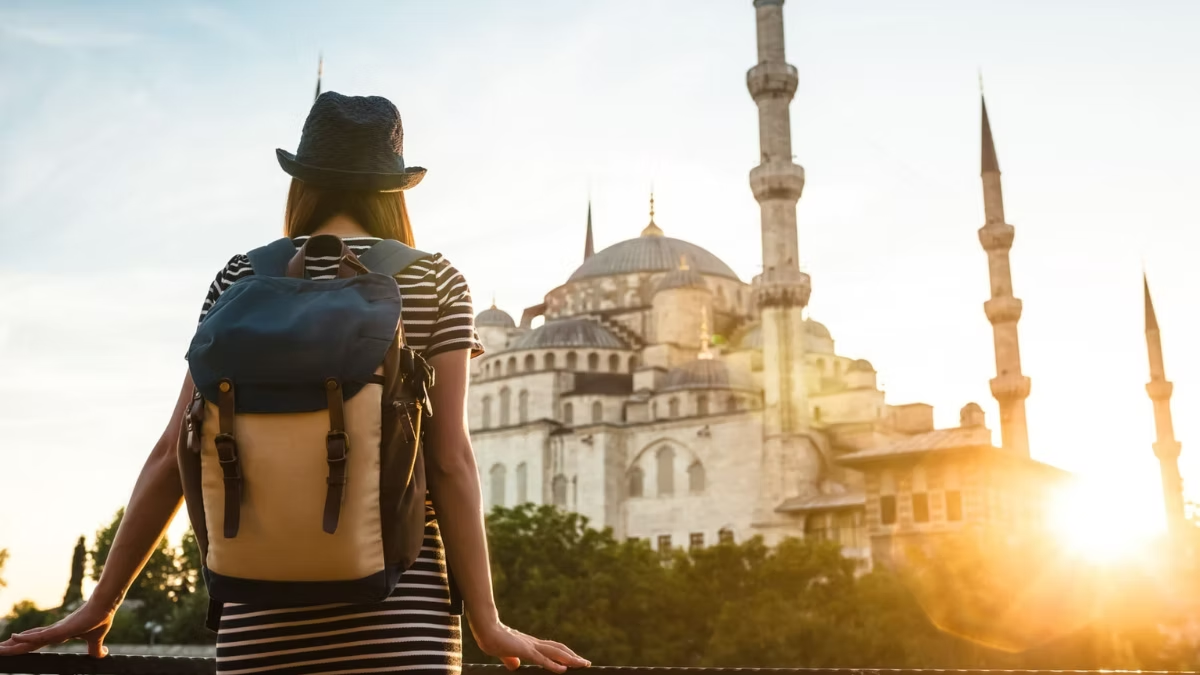
The most important Blue Mosque visitor tips are: arrive at 08:30 sharp on a mid-week morning, use the south-side tourist entrance (not the main gate), wear slip-on shoes and bring your own headscarf if you are a woman, look up immediately upon entering, and do not panic if you are turned away for prayer — the wait is never more than 45 minutes and the courtyard is always accessible.
Visiting the Blue Mosque is straightforward once you know how it works. Entry is free, there are no tickets to book, and the rules are simple. But there is a meaningful gap between a visit where you shuffle through in 20 minutes feeling vaguely rushed, and one where you stand still in the prayer hall, genuinely struck by the scale and beauty of the place. The tips below are drawn from the experiences of seasoned travellers and local guides, and they are designed to close that gap.
Before You Arrive
Check the day’s prayer times before you leave your hotel
Prayer times at the Blue Mosque shift by a few minutes every day, calculated by the position of the sun. The two closures that most commonly catch tourists off guard are the midday Dhuhr prayer (roughly 13:00–14:30) and the afternoon Asr prayer (roughly 15:30–17:00 in summer). Checking the Turkish Directorate of Religious Affairs website or a prayer times app before you leave gives you the full picture and lets you plan your arrival window with confidence. Full details in our opening hours guide.
Do not visit on a Friday morning
Friday is Jumu’ah — the most important weekly prayer in Islam — and the mosque does not open to non-Muslim visitors until 14:30. If Friday is your only day in Istanbul, spend the morning at Hagia Sophia or the Basilica Cistern and come to the Blue Mosque in the mid-afternoon once the initial post-Jumu’ah rush has passed.
Dress before you leave — do not rely on the mosque’s loaner items
The mosque provides free scarves and robes at the entrance, but during peak season (June–August) a queue can form at the clothing stand that adds 10–15 minutes to your entry. Arriving already dressed correctly — shoulders and knees covered, women with a scarf — means you walk straight through security with no delay. See our full dress code guide for specifics.
Wear slip-on shoes
You will remove your shoes before entering the prayer hall and carry them in a plastic bag provided at the entrance. Shoes with multiple laces slow you down and slow down everyone behind you. Slip-on loafers, sandals, or trainers with easy fastenings make the process seamless.
Bring clean socks
The mosque’s carpets are expansive and the floors beneath them can be cold, particularly in winter. Socks are practical and also more comfortable than walking barefoot across carpets that thousands of visitors cross daily.
At the Entrance
Use the tourist entrance, not the main gate
The main gate on the north side of the mosque (facing the Hippodrome) is reserved for worshippers. The tourist entrance is on the south side, across from Hagia Sophia. Signs direct you there from Sultanahmet Square, and mosque staff at the gate will redirect you if you approach the wrong door. Using the correct entrance avoids confusion and saves time.
A rope across the entrance means a prayer closure — not a permanent closure
This is the single most common source of frustration among first-time visitors. If you arrive and find a rope or barrier across the tourist entrance with staff indicating you cannot enter, the mosque is temporarily closed for prayer — not shut for the day. The wait is almost always 30–45 minutes. The courtyard is always accessible. Sit on the steps, walk around the exterior, or visit the Hippodrome directly opposite. When the closure ends, entry resumes naturally — you do not need to queue at a specific point.
Security is mandatory — factor it in
All visitors pass through a bag check and security screening before entering. During peak season, this adds 10–20 minutes to entry time. Arriving slightly before the opening time (08:25–08:28) puts you at the front of any queue that forms.
Approach the mosque from the Hippodrome side first
Before entering, take a few minutes to walk around the mosque’s exterior from the west, approaching from the Hippodrome. This is the best angle from which to appreciate the full cascade of domes — the central dome flanked by four semi-domes, then smaller domes rippling outwards, with the six minarets rising above. Understanding the exterior geometry before you step inside makes the interior far more legible.
Inside the Mosque
Look up the moment you enter
The natural instinct on entering the Blue Mosque is to look around at the walls and the crowds. Resist it. Look straight up first. The central dome soars 43 metres above you, and the full cascade of semi-domes, decorative arches, and the 260 stained-glass windows becomes immediately apparent. The light filtering through those windows — warm and soft in the morning, golden in the late afternoon — changes the character of the entire space. Give yourself 60 seconds just to absorb the ceiling before doing anything else.
The prayer hall is roped off — visitors stay to the sides and back
A large central section of the prayer hall is reserved for worshippers and is marked off with ropes. Visitors circulate around the perimeter and at the back. Do not step over the ropes or enter the central prayer area. This boundary is clearly marked and staff will redirect anyone who accidentally crosses it.
Do not walk in front of someone who is praying
The Blue Mosque is an active place of worship and Muslims pray here throughout the day. If you see someone in prayer — kneeling, bowing, or prostrating — do not walk directly in front of them. Walk behind them or wait. This is one of the most fundamental signs of respect in a mosque context.
Flash photography damages the tiles — turn it off
Photography is permitted inside the Blue Mosque, and the interior is genuinely worth photographing. However, flash photography is strictly forbidden. The intense light from a flash is harmful to the 400-year-old Iznik tiles and disturbing to worshippers. Turn your flash off before entering and leave it off. Modern smartphone cameras perform well in the mosque’s ambient light, particularly in the morning when the natural light through the windows is at its best. Our photo guide has the best interior spots.
Keep your voice low
The mosque’s prayer hall is acoustically resonant — voices carry significantly. Keep conversations quiet and brief. This is not only respectful to worshippers but also to other visitors trying to absorb the space in peace.
Look for the details, not just the scale
The Blue Mosque’s overwhelming first impression is of scale — the height of the dome, the expanse of the carpeted floor. Once that settles, slow down and look at the details. The 20,000 Iznik tiles covering the lower walls feature more than 50 different tulip designs alongside roses, carnations, lilies, and cypress trees. The calligraphy panels on the walls contain verses from the Quran in the hand of the great 17th-century calligrapher Kasım Gubarî. The stained-glass windows are replacements of the originals but maintain the same patterns. Each of these elements rewards close attention. See our interior highlights guide for a full breakdown.
Visit the Islamic Information Centre after your tour
Just outside the exit, the mosque operates a free Islamic Information Centre staffed by multilingual volunteers. This is an underused resource. The centre offers brochures, books, and knowledgeable staff who can answer questions about the mosque’s architecture, the meaning of the calligraphy, the symbolism of the geometric tile patterns, and the basics of Islamic practice — all in a relaxed, no-pressure environment. Spending 15 minutes here after your visit can transform what you have just seen from a visual experience into a genuinely educational one.
Practical Management
Allow 45–60 minutes inside
The standard advice of 20–30 minutes is on the short side for a first visit. If you arrive at a calm moment, 45–60 minutes inside allows you to absorb the central prayer hall fully, walk the full perimeter, examine the tile work closely, and spend time simply sitting and looking — which is arguably the most rewarding thing you can do in the space. If you are visiting with a guided tour, 60–90 minutes is typical.
Do not stack too many interior-heavy sites back-to-back
A very common mistake in Sultanahmet is visiting the Blue Mosque, Hagia Sophia, the Basilica Cistern, and Topkapi Palace all in succession without breaks. Attention fatigue sets in quickly when moving between grand interior spaces. The Blue Mosque, Hagia Sophia, and the Basilica Cistern make a natural and satisfying combination for a single day. Save Topkapi Palace for a fresh morning. See our Sultanahmet day plan for the recommended order.
Donations are appreciated but never required
Entry is free for all visitors. Donation boxes are located at the exit — contributions support the mosque’s ongoing maintenance and conservation. There is no obligation, and no one will pressure you. If you have had a meaningful experience, a small donation is a respectful way to acknowledge it.
A guided tour solves most of the logistical problems
If the prayer closure timing, dress code preparation, and entrance navigation all feel like a lot to manage, a guided tour takes care of all of it automatically. A good guide will time the visit around the prayer schedule, brief you on dress code before arrival, use the correct entrance, and give you the historical and architectural context that makes the space genuinely intelligible. The Blue Mosque guided tour is the most popular single-mosque option. For visitors who want to cover more ground, the Blue Mosque + Hagia Sophia + Basilica Cistern tour handles all three in one efficiently managed morning.
Quick Reference Checklist
Before you go:
- Check today’s prayer times
- Dress appropriately — shoulders and knees covered, scarf for women
- Wear slip-on shoes and clean socks
- Avoid Fridays before 14:30
At the entrance:
- Use the south-side tourist entrance, not the main gate
- If there is a rope, wait — it is a prayer closure, not a permanent closure
- Allow 10–20 min for security during peak season
Inside:
- Look up immediately upon entering
- Stay behind the ropes marking the prayer area
- Flash off, voice low
- Allow 45–60 minutes — do not rush
For announcements, prayer-time updates, and any visit-rule changes, the official Blue Mosque website is the only authoritative source.
