
Blue Mosque Architecture: The Six Minarets & Grand Domes
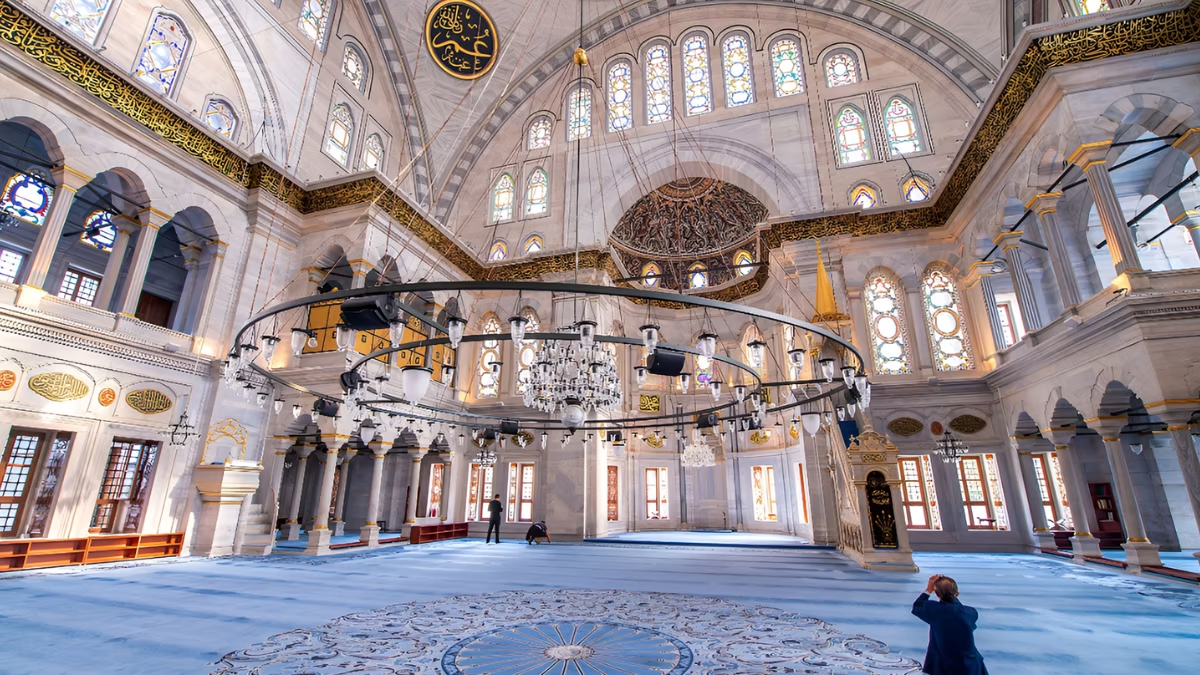
The Blue Mosque (Sultan Ahmed Mosque) was designed by Sedefkâr Mehmed Ağa and built between 1609 and 1617. It features one central dome 43 metres high and 23.5 metres in diameter, surrounded by four semi-domes and eight secondary domes, plus six minarets — the only mosque in Istanbul with six. The six minarets caused immediate controversy, as at the time only the Grand Mosque in Mecca had that many. Sultan Ahmed I resolved the dispute by funding a seventh minaret for Mecca.
Architecture is the first thing that strikes you about the Blue Mosque, even before you step inside. From Sultanahmet Square, the silhouette is unmistakable: six slender minarets rising against the Istanbul sky, a central dome flanked by a cascade of semi-domes descending in perfect symmetry on four sides, and below these, the vast courtyard with its own domed arcade creating a second, lower tier of the composition. The whole thing reads as a single coherent form — a dome mountain — rather than a collection of individual elements.
This article unpacks that form: who designed it, how it was built, where the ideas came from, and what makes it distinctive within the broader tradition of Ottoman imperial mosque architecture.
The Architect: Sedefkâr Mehmed Ağa
The Blue Mosque was designed by Sedefkâr Mehmed Ağa, chief imperial architect to the Ottoman court from 1606. Albanian-born and trained in the palace schools of Istanbul, he earned his name “Sedefkâr” — meaning worker in mother-of-pearl inlay — from his original craft before becoming an architect. He was the last significant pupil of Mimar Sinan, the 16th-century master who defined classical Ottoman architecture. The Blue Mosque was, according to his official biographer, the culmination of Mehmed Ağa’s career.
Mehmed Ağa’s training under Sinan was decisive. Sinan had spent decades refining the Ottoman mosque form — taking the Byzantine spatial legacy of Hagia Sophia and transforming it through the lens of Islamic function and aesthetic — and Mehmed Ağa inherited that tradition completely. His particular contribution was a more “sculptural” approach, as architectural historian Doğan Kuban describes it: where Sinan favoured rigorous spatial design with restrained decoration, Mehmed Ağa was willing to break forms into smaller parts and add elaborate surface detail. The Blue Mosque is the fullest expression of that tendency.
He also had direct experience of Hagia Sophia — he had supervised repair and renovation work on the Byzantine structure, and its dome system was one of the primary references for his own design directly opposite. The challenge he faced was how to build something that could hold its own visually against a building that had dominated Istanbul’s skyline for over a thousand years. His answer was mass, cascading symmetry, and the unprecedented six minarets.
The Dome System
The Blue Mosque’s dome system consists of one central dome (23.5 metres in diameter, 43 metres high), four semi-domes each flanking the central dome, and eight secondary exedra domes filling the corners and transitions. The courtyard has 30 additional domes over its arcaded portico. The whole system was modelled primarily on Sinan’s Şehzade Mosque (1548) but scaled up significantly and given a softer, more fluid profile on the exterior.
The structural logic of the dome system is essentially this: the central dome generates enormous lateral outward thrust. Directly adjacent semi-domes absorb and redirect that thrust. Beyond those, smaller exedra and the walls carry the remaining load to the ground. This cascading arrangement — dome into semi-dome into smaller dome into arch and wall — is what creates the characteristic silhouette of the great Ottoman imperial mosques, and the Blue Mosque is its most fully developed expression.
The central dome rises 43 metres above the prayer hall floor — roughly equivalent to a 14-storey building — and spans 23.5 metres in diameter. It sits on four pendentives (the curved triangular surfaces in the corners that transition from the square base to the circular dome rim). The central dome is slightly smaller than Hagia Sophia’s (31.24 metres), though the overall impression of height and space inside the Blue Mosque is comparable because the floor-to-dome ratio and the lighting approach are similar.
The four semi-domes are positioned at the cardinal points — north, south, east, and west — around the central dome. Each semi-dome spans roughly the same distance as the central dome and is flanked by three smaller semi-domes (exedrae). This creates a cross-shaped spatial plan at roof level, with the four corners of the rectangular prayer hall covered by four smaller domes independently.
The courtyard dome system adds a further layer: the peristyle arcade surrounding the rectangular courtyard carries 30 domes of uniform height. Mehmed Ağa made a subtle but significant decision here — he kept these courtyard arcade domes at nearly the same height on all four sides, whereas Sinan’s courtyards traditionally made the portico in front of the prayer hall taller than the other three. This choice prioritises uniformity and smoothness of profile over hierarchical drama.
On the exterior, Mehmed Ağa deliberately created a softer profile than Sinan’s buildings. Rather than the sharp juxtaposition of curved domes against vertical elements that Sinan favoured, Mehmed Ağa used more curved and multi-tiered supporting elements to build the composition smoothly upward from the courtyard level to the summit of the central dome — a long, gradual mountain rather than an abrupt peak.
The Six Minarets: A Controversy That Echoes to Mecca
The Blue Mosque has six minarets — four at the corners of the main prayer hall and two at the front corners of the courtyard. At the time of its construction (1609–1617), six minarets was an almost unheard-of number: only the Grand Mosque in Mecca possessed six. The Ottoman religious establishment considered it an act of presumption. Sultan Ahmed I resolved the controversy by funding the construction of a seventh minaret at the Grand Mosque in Mecca — restoring Mecca’s supremacy while allowing Istanbul’s new mosque to keep its six.
The six minarets are the most immediately distinctive feature of the Blue Mosque’s exterior. Most Ottoman imperial mosques have four minarets; some have two. Six was without precedent in Istanbul and created immediate religious backlash. The religious scholars (ulema) of the empire objected on the grounds that equalling Mecca’s minaret count implied a claim to sacred equivalence that was theologically improper. Sultan Ahmed I’s diplomatic solution — paying for the seventh minaret in Mecca — turned the controversy into an act of piety and generosity rather than hubris.
A popular legend attributes the six minarets to a misunderstanding: the sultan is said to have asked for minarets “made of gold” (altın minareler in Turkish), and his architect misheard this as “six minarets” (altı minare). While this story has been retold for centuries, no historical documentation confirms it. What is documented is the religious controversy and its resolution.
The four taller minarets are positioned at the corners of the main prayer hall. Each has three balconies (şerefe) — the projecting galleries from which the muezzin traditionally delivered the call to prayer (ezan). The balconies are decorated with muqarnas corbelling (intricate stalactite-like carving), and the minaret shafts are fluted — a refinement that Mehmed Ağa applied individually, making each minaret’s fluting pattern subtly different from the others.
The two shorter minarets stand at the front corners of the outer courtyard. These have only two balconies each and are shorter in proportion to the main minarets. Together, the six form a visual frame around the entire complex when viewed from Sultanahmet Square — the four tall minarets rising above the prayer hall, the two shorter ones flanking the courtyard entrance.
The Courtyard
The courtyard of the Blue Mosque is among the largest of any Ottoman imperial mosque — nearly equal in area to the prayer hall itself. This unusual proportion was a deliberate design choice reflecting the social and religious function of the space: the courtyard served as a gathering area for worshippers before prayer, a transitional zone between the busy city outside and the sacred interior, and an outdoor extension of the mosque’s spatial experience.
The courtyard is entered through three gates: a monumental central gateway on the northwest (the most ceremonial, with a projecting portal topped by a small dome and decorated with muqarnas) and two side gates. A large iron chain is suspended across the upper portion of the central gate — a detail that required even the sultan, when entering on horseback, to bow his head. The gesture of physical humility before entering a holy place was deliberate and encoded in the architecture.
At the centre of the courtyard stands the şadırvan — an octagonal domed kiosk with a fountain originally used for ritual ablutions before prayer. Its outer surfaces are carved with low-relief foliate ornament. Today the ablutions are performed at modern water facilities along the courtyard walls, and the şadırvan is primarily decorative.
The peristyle arcade surrounding the courtyard is supported by 26 columns of marble and porphyry with elaborately carved capitals. The 30 domes above the arcade are of uniform height, giving the courtyard a calm, measured quality distinct from the dramatic vertical thrust of the prayer hall behind it.
Comparing the Blue Mosque and Hagia Sophia
The two buildings face each other across Sultanahmet Square, and their architectural relationship is one of the most interesting in the world. Sultan Ahmed I specifically chose the site to rival Hagia Sophia in the most direct possible way — building the Ottoman answer to the Byzantine masterpiece directly in front of it.
| Feature | Blue Mosque | Hagia Sophia |
|---|---|---|
| Built | 1609–1617 | 532–537 AD |
| Central dome diameter | 23.5 m | 31.24 m |
| Central dome height | 43 m | 55.6 m |
| Minarets | 6 | 4 (added post-1453) |
| Architectural tradition | Ottoman | Byzantine |
| Entry | Free | Paid |
| Still a mosque | Yes (active) | Yes (converted 2020) |
Hagia Sophia’s dome is larger and taller, and by conventional architectural analysis it is the more structurally daring achievement. But the Blue Mosque’s cascading dome system — multiple semi-domes stepping up from the courtyard level to the central crown — creates a more coherent and unified exterior silhouette. The two buildings represent different answers to the same fundamental question: how do you build an interior space large enough to hold thousands of people in prayer while making the architecture itself feel like an act of devotion?
The Külliye: The Mosque as a Social Complex
The Blue Mosque was not built in isolation but as the centrepiece of a külliye — an Ottoman social and religious complex. The full complex originally included a madrasa (Islamic school), a hospital, a primary school (mektep), a public kitchen (imaret) for the poor, a caravanserai for travellers, market shops whose rental income supported the mosque’s maintenance, and the mausoleum of Sultan Ahmed I.
This integration of worship with education, healthcare, and social welfare was characteristic of Ottoman imperial mosque complexes and represented a complete vision of the mosque as a civic institution, not merely a place of prayer. Several of these buildings survive in various states of preservation in the streets surrounding the mosque.
The 2023 Restoration
The Blue Mosque underwent a major restoration project that concluded with the mosque’s full reopening to visitors in April 2023. The works included:
- Cleaning and conservation of the calligraphic inscriptions on the central dome (a 38-metre internal scaffolding structure was required)
- Structural repairs to the domes, with lead roof coverings renewed
- Full restoration of three minarets — each stone was numbered, removed, restored, and reassembled in its original position
- Replacement of all inner and outer window shutters
- Levelling and repair of the courtyard flooring
- Redesign of underground drainage channels
The mosque is now fully accessible to visitors without the restricted access that characterised the restoration period. All interior areas that were previously visible to visitors remain so.
Frequently Asked Questions
Why does the Blue Mosque have six minarets?
Six was an unprecedented number for an Ottoman mosque outside Mecca. The most widely accepted historical explanation is that Sultan Ahmed I deliberately commissioned six as an expression of imperial ambition and religious devotion. The resulting controversy with religious scholars was resolved when Ahmed I funded a seventh minaret for the Grand Mosque in Mecca. A popular legend claims it was a misunderstanding between “gold” (altın) and “six” (altı) in Turkish, but this is unverified folklore.
Who was the architect of the Blue Mosque?
Sedefkâr Mehmed Ağa, chief imperial architect of the Ottoman Empire from 1606. Albanian-born and trained in the Ottoman palace schools, he was a pupil of Mimar Sinan and the last great architect of the classical Ottoman period. The Blue Mosque was his most ambitious and celebrated work.
How many domes does the Blue Mosque have?
The mosque has one central dome, four semi-domes, eight secondary exedra domes covering the corners and transitions, and 30 domes over the courtyard arcade — 43 domes in total across the complex.
Is the Blue Mosque bigger than Hagia Sophia?
Hagia Sophia’s central dome is larger (31.24m diameter vs 23.5m) and taller (55.6m vs 43m). In terms of overall footprint and floor area, the two buildings are comparable. The Blue Mosque’s courtyard is significantly larger than Hagia Sophia’s.
When was the Blue Mosque built?
Construction began in 1609 and the main structure was completed in 1616. The mosque was officially opened for worship on 9 June 1617, though decorative work continued after that date. Sultan Ahmed I died in November 1617, the same year the mosque opened, at the age of 27.
