
Blue Mosque Courtyard & Exterior: What to Look For
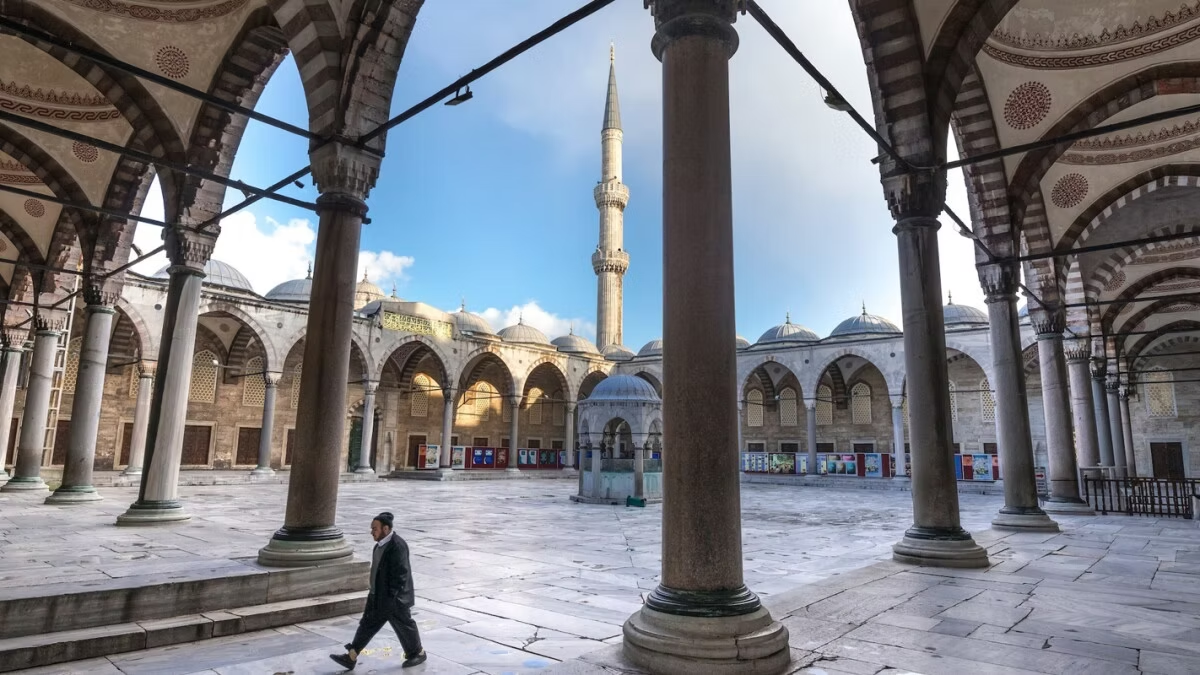
The Blue Mosque’s courtyard measures approximately 70 by 80 metres — nearly as large as the prayer hall itself — and is surrounded by a colonnaded arcade of 26 columns supporting 30 domes. At its centre stands an octagonal şadırvan (ablution fountain). The courtyard has three entrance gates, the most significant being the northwest gate from the Hippodrome, where a heavy iron chain forces even the sultan to bow his head. Visiting the courtyard is free, requires no dress code, and is accessible even during prayer closures.
Most visitors to the Blue Mosque focus their attention on the interior prayer hall, and understandably so — the Iznik tiles, the soaring dome, and the filtered coloured light are extraordinary. But the exterior and courtyard of the mosque reward careful attention in their own right. The cascade of domes visible from Sultanahmet Square, the iron chain at the northwest gate, the carved details of the şadırvan, the inscriptions above the doorways, the Sultan Ahmed I mausoleum in the garden beyond — these are elements that most visitors walk past without looking at closely.
This guide covers everything outside the prayer hall: the exterior silhouette, the three entrance gates, the courtyard, the şadırvan fountain, the minarets in detail, and the surrounding külliye buildings including the mausoleum and the Arasta Bazaar.
The Exterior Silhouette: Reading the Dome Cascade
The Blue Mosque’s exterior is defined by a cascading dome system visible from Sultanahmet Square: one central dome (23.5m diameter, 43m high) flanked by four semi-domes, then smaller exedra domes filling the transitions, and finally the 30 domes of the courtyard arcade at the lowest level. Six minarets — four at the corners of the prayer hall and two at the front corners of the courtyard — frame the entire composition. The exterior stone is limestone, warm grey-beige in daylight and golden under the mosque’s evening floodlighting.
Before entering the courtyard, spend a few minutes reading the exterior from different positions. The best approach for understanding the architecture is from the Hippodrome to the west, where you can see the full profile — dome cascade, minarets, and courtyard arcade — without anything blocking the sightline. Walking around the mosque’s full perimeter takes approximately 15 minutes and reveals several elements not visible from the main square.
From Sultanahmet Square (north side): The central dome appears directly above the courtyard arcade, framed by the four taller minarets. The courtyard gate is in the foreground. This is the classic postcard angle.
From the Hippodrome (west side): The mosque’s western façade shows the full cascade from dome to semi-dome to the lower arcades of the courtyard. The six minarets are visible in profile. The iron chain at the entrance gate (see below) is visible from this approach.
From the Arasta Bazaar side (south side): The mosque’s south exterior, rarely photographed, reveals the tourist entrance and shows the dome system from an angle that makes the semi-dome arrangement particularly clear.
From Sultanahmet Park (northeast): Looking back toward the mosque from the garden between it and Hagia Sophia, the full northwestern façade is visible with the courtyard in the foreground. In April, the tulip gardens provide a vivid foreground element. This is the best position for the double-mosque composition — Blue Mosque and Hagia Sophia in a single frame.
The Three Entrance Gates
The courtyard has three entrance gates in its outer enclosure wall:
The Northwest Gate (Main Ceremonial Gate, from the Hippodrome)
This is the most architecturally significant entrance and the one worth examining most closely. It features a tall projecting portal topped by a small dome raised on a drum — the most monumental of the three gates, standing slightly apart from the arcade in a way that marks it as ceremonial. Above the exterior doorway is a muqarnas semi-vault (the intricate stalactite-like stone carving that appears throughout the mosque) and two inscription panels containing Quranic verses.
Most importantly, look for the heavy iron chain hanging in the upper section of this gate. This chain was deliberately positioned low enough that the Ottoman sultan, entering on horseback during ceremonial occasions, was forced to lower his head to avoid hitting it. The gesture encoded a theological and political idea: even the most powerful person on earth bows before God when entering a holy space. The sultan’s power was absolute in secular matters but symbolically subordinate to the divine the moment he crossed this threshold. The chain remains in place today — look for it as you enter from the Hippodrome side.
The Northeast and Southwest Gates (Side Entrances)
The two side gates are simpler in design — less projecting, less elaborately decorated — and were used for ordinary congregational access. Today, tourists typically enter the courtyard from the south side, near the Hippodrome.
The Courtyard (Avlu)
The Blue Mosque’s courtyard is a rectangular peristyle space measuring approximately 70 by 80 metres — nearly equal in area to the prayer hall it precedes. It is lined on all four sides by a colonnaded arcade (riwaq) of 26 columns in marble and porphyry supporting 30 domes. The floor is paved with marble from the island of Marmara. At the centre stands the şadırvan, an octagonal domed kiosk housing an ablution fountain. The courtyard is always open to visitors and requires no dress code.
The courtyard is one of the most serene spaces in Sultanahmet. Unlike the crowded interior, the courtyard — particularly in the morning or early afternoon — often has a calm, unhurried quality. Visitors sit along the arcade walls, rest after the security queue, or simply absorb the scale of the space before entering the prayer hall.
Several architectural details of the courtyard reward close attention:
The arcade (riwaq): Walk slowly along the colonnaded portico that lines all four sides. The 26 columns are of varying heights (a practical accommodation to the sloping site) with elaborately carved capitals. Look at the domes above — 30 in total, each slightly different in their carved ornamental details at the pendentive transitions. Unlike the courtyard arcades of Sinan’s great mosques (the Süleymaniye and the Selimiye), where the portico in front of the prayer hall is taller than the other three sides, Mehmed Ağa kept all four sides at approximately the same height. This prioritises uniformity over hierarchy and gives the courtyard a more enclosed, unified quality.
The marble floor: The paving is Marmara marble — the same white marble used extensively in Ottoman imperial buildings throughout the 16th and 17th centuries. Notice how it reflects the sky and the arcade above, particularly after rain.
The turrets on the corner domes: The corner domes of the courtyard arcade are topped with small decorative turrets — a feature borrowed from the Süleymaniye Mosque’s courtyard and adapted here. They punctuate the roofline of the arcade at the corners, adding vertical interest at a lower level than the minarets.
The Şadırvan: The Ablution Fountain
At the centre of the courtyard stands the şadırvan — an octagonal domed kiosk enclosing the ablution fountain. The word şadırvan refers specifically to this type of covered fountain in a mosque courtyard, used historically for the ritual washing (wudu) that Muslims perform before prayer: hands, face, mouth, nose, arms to the elbow, and feet.
At the Blue Mosque, the şadırvan’s exterior surfaces are carved with low-relief foliate ornament — stylised leaves, flowers, and vines — that complement the Iznik tile decoration inside the prayer hall. The dome above is small and lightly decorated. The fountain basin inside has several spigots, though today the actual ablutions are performed at modern water facilities in covered arcades along the outer courtyard walls (northeast and southwest sides), leaving the şadırvan primarily as a decorative and historical element.
One detail worth noting: the şadırvan appears relatively small in relation to the vast courtyard around it. This was a deliberate proportional decision — the fountain is not meant to dominate the space but to provide a focal point at the centre of a larger open area.
The Minarets in Detail
The six minarets of the Blue Mosque are among the most recognisable elements of Istanbul’s skyline, and they reward close examination at ground level as well as from a distance.
The four taller minarets stand at the corners of the prayer hall and rise to approximately 64 metres. Each has three balconies (şerefe) — projecting galleries from which the muezzin traditionally climbed to deliver the call to prayer (ezan). Today the call is broadcast by loudspeaker, but the balconies remain and are occasionally used for ceremonial occasions. The balconies are decorated with muqarnas corbelling — the same stalactite carving used over the entrance gates.
The minaret shafts are fluted — a classical Ottoman decorative treatment — and each minaret’s fluting pattern is subtly different from the others. This was a distinctive decision by architect Sedefkâr Mehmed Ağa, who went beyond the standard Ottoman practice of plain minaret bodies to introduce individual decorative character to each tower.
The two shorter minarets stand at the front corners of the courtyard and have two balconies each rather than three. They are shorter in proportion to the main minarets, creating a visual hierarchy that emphasises the prayer hall’s minarets over the courtyard’s — though from most exterior viewpoints, all six read as a unified ensemble.
At the very top of each minaret is a conical cap (külah) with a metal alem — the crescent-and-star finial. The alems were restored as part of the 2023 renovation, and their gilding catches the light particularly at dawn and dusk.
The Sultan Ahmed I Mausoleum (Türbe)
Immediately to the northeast of the mosque, in a walled garden facing Sultanahmet Square, stands the mausoleum of Sultan Ahmed I — the man who commissioned and built the Blue Mosque. He died on 22 November 1617, at the age of 27, just six months after the mosque opened for worship, and requested to be buried beside his greatest creation.
The mausoleum (türbe) was begun in 1619 after his death and completed under his son Osman II. Unlike most Ottoman imperial mausoleums, which traditionally have an octagonal floor plan, Ahmed’s türbe has a square plan covered by a dome — more reminiscent of a small mosque than the standard mausoleum form. The exterior is faced with Iznik tiles and the interior contains the sultan’s sarcophagus along with those of his wife Kösem Sultan and several of his sons.
The mausoleum is open to visitors and entry is free. It is a peaceful and often overlooked space — most visitors walk past without entering. The interior tilework, while on a smaller scale than the mosque, is of comparable quality and provides a more intimate encounter with the Iznik tile tradition.
The Sultan Ahmed I Primary School
Along the outer courtyard wall on the eastern side of the mosque stands a small building identified as the Sultan Ahmed Sıbyan Mektebi — the primary school of the külliye complex. Built on a simple square plan with a single domed room and two rows of windows, it was destroyed by fire in 1912 and later rebuilt. Today it is used for free educational presentations on the history and architecture of the Blue Mosque — an underused resource that offers genuine historical context about the site.
The Arasta Bazaar
Running along the southeastern exterior wall of the mosque, the Arasta Bazaar is a covered Ottoman-era market that was part of the original külliye complex completed in 1617. Around 70 shops selling ceramics, textiles, Iznik tile reproductions, carpets, and jewellery operate in the arcade. The rental income from these shops was originally designated to fund the mosque’s maintenance and upkeep — a standard arrangement in Ottoman külliye complexes where commercial activity supported religious and charitable institutions.
The Arasta also provides access to the Mosaic Museum (Büyük Saray Mozaikleri Müzesi), located beneath the bazaar and containing Byzantine floor mosaics from the 6th-century Great Palace of Constantinople — the palace that previously occupied this site before the mosque was built. If you have a particular interest in Byzantine history, these mosaics are one of the finest surviving examples of the form in the city.
The Arasta is a calmer, more pleasant shopping environment than the Grand Bazaar — worth a 20–30 minute browse after visiting the mosque. Details on combining the Blue Mosque with nearby attractions are in our Sultanahmet day plan.
What You Can See During Prayer Closures
When the prayer hall is closed to visitors during the five daily prayer times, the courtyard and all exterior areas remain fully accessible. This is worth remembering: a prayer closure is not a full closure. You can:
- Walk the full courtyard perimeter under the arcade
- Examine the şadırvan fountain up close
- Look for the iron chain at the northwest gate
- Photograph the exterior from all sides
- Visit the Sultan Ahmed I mausoleum
- Browse the Arasta Bazaar
For a full guide to prayer closure windows and timing, see our opening hours guide.
Frequently Asked Questions
Is the courtyard of the Blue Mosque free to visit?
Yes. The courtyard is free to enter and has no dress code requirements. The dress code (covered shoulders and knees for all visitors, headscarf for women) applies only when entering the prayer hall.
Can you photograph the Blue Mosque courtyard?
Yes, with no restrictions. Tripods are permitted in the courtyard. It is one of the best photography locations at the mosque — the şadırvan, the arcade columns, and the minarets rising above the courtyard domes all offer strong compositional elements.
What is the iron chain at the Blue Mosque entrance?
The heavy iron chain hanging at the northwest (Hippodrome-side) entrance gate was positioned deliberately low enough to require the Ottoman sultan to bow his head when entering on horseback. It was a symbolic gesture encoding the idea that even the most powerful ruler bows before God. The chain remains in place today and is one of the most historically interesting details of the courtyard.
Can you visit Sultan Ahmed I’s tomb at the Blue Mosque?
Yes. The mausoleum (türbe) of Sultan Ahmed I stands in a garden immediately northeast of the mosque, facing Sultanahmet Square. It is free to enter and open to visitors. It contains the sarcophagi of Sultan Ahmed I, his wife Kösem Sultan, and several of his sons.
What is the şadırvan?
The şadırvan is the covered ablution fountain at the centre of the courtyard — an octagonal domed kiosk housing a basin with multiple water spigots, historically used by worshippers for the ritual washing performed before Islamic prayer. At the Blue Mosque, actual ablutions are now performed at modern facilities along the outer courtyard walls; the şadırvan serves primarily as a decorative historical element.
