
Blue Mosque Interior: Domes, Tiles & Calligraphy
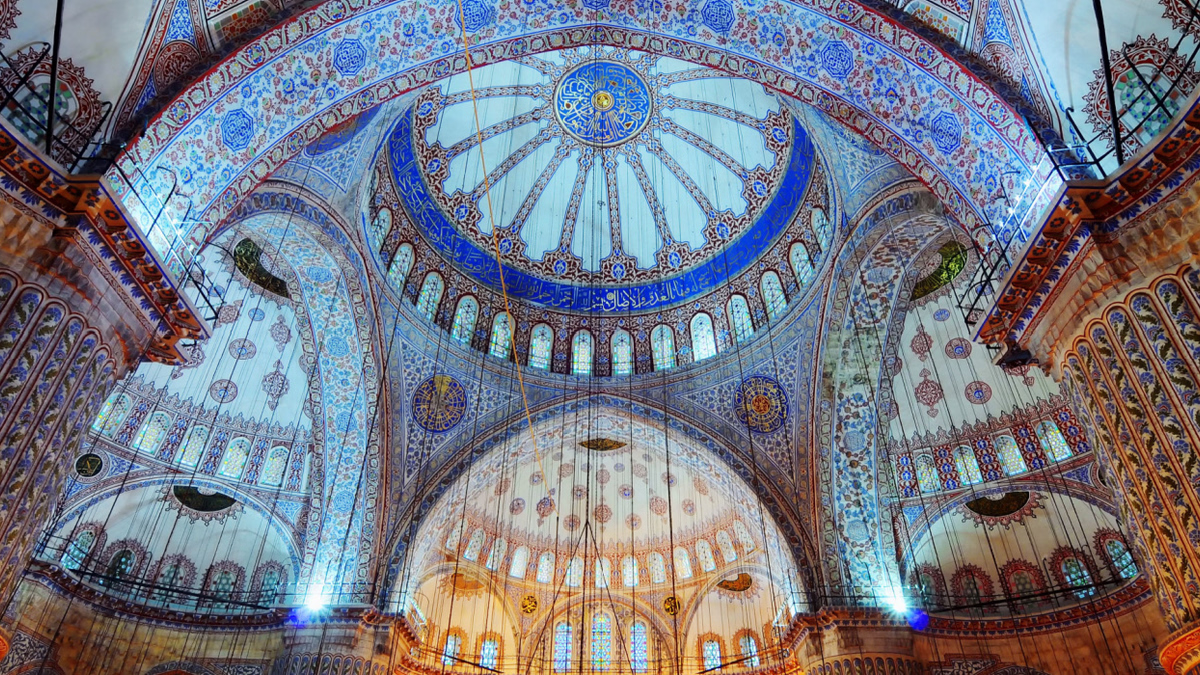
The Blue Mosque interior is defined by four elements: 21,043 hand-painted Iznik ceramic tiles in over 50 floral and geometric designs that cover the lower walls and galleries; a central dome measuring 23.5 metres in diameter rising 43 metres above the prayer hall; 260 stained-glass windows that flood the space with coloured light; and calligraphic inscriptions in Quranic verses executed by the celebrated Ottoman master Seyyid Kasım Gubari. Together these create one of the most extraordinary interior spaces in the Islamic world.
The name “Blue Mosque” is both accurate and slightly misleading. Step inside and you will immediately understand where it comes from — thousands of hand-painted ceramic tiles in shades of cobalt, turquoise, and sea green transform the lower walls into something that feels less like stone and more like a garden suspended in time. But the blue is only one layer of what is happening in this interior. Above the tilework, the painted arabesques shift toward red and gold. Above those, the domes open up into geometric calligraphy inscribed at the apex of heaven. Light arrives from 260 windows, changes colour as it passes through the glass, and lands differently on every surface at every hour of the day.
This guide breaks down the key elements of the Blue Mosque interior so that when you visit, you are looking at specific things rather than simply being overwhelmed by the whole.
The Prayer Hall: First Impressions
The Blue Mosque’s prayer hall measures 64 by 72 metres and can accommodate up to 10,000 worshippers. It is one of the largest prayer halls of any Ottoman imperial mosque. Four massive columns — known as “elephant feet” (fil ayağı), each five metres in diameter — support the central dome. The floor is covered entirely in carpet, and the roped-off central section is reserved for Muslim worshippers during prayer times.
The first thing most visitors do upon entering is scan the walls at eye level. The better instinct is to look up. The spatial logic of the prayer hall is vertical — a cascade of domes descending from the central dome downward through four semi-domes, then to smaller exedrae, then finally to the arcaded galleries at the sides. Understanding this geometry from below is one of the most rewarding things you can do in the space.
The four elephant-foot pillars are the most architecturally controversial element of the mosque. They are structurally necessary — carrying the enormous load of the central dome — but their bulk interrupts the sight lines and creates a visual heaviness that contemporary architectural historians noted critically, comparing the design unfavourably to the more spatially refined mosques of Mimar Sinan. For the visitor, however, they provide a useful navigational anchor: stand between any two of them and you are at the centre of the prayer hall, looking directly up at the dome.
The Central Dome
The Blue Mosque’s central dome is 23.5 metres in diameter and rises to 43 metres above the floor — roughly the height of a 14-storey building. It is surrounded by four semi-domes of similar scale, each flanked by three smaller semi-domes, creating a cascading effect that distributes the dome’s visual and structural weight outward and downward. The interior of the dome is decorated with painted arabesques and a ring of calligraphic inscription at its apex.
The dome system of the Blue Mosque was modelled closely on that of the Şehzade Mosque, Mimar Sinan’s early 16th-century masterpiece, itself influenced by the Byzantine dome of Hagia Sophia across the square. Architect Sedefkâr Mehmed Ağa — Sinan’s pupil and the designer of the Blue Mosque — used the same cascading semi-dome arrangement but pushed the scale further and added more elaborate decoration throughout.
At the apex of the central dome, the calligraphy ring inscribes what scholars identify as verses emphasising God’s role as creator and sustainer of the heavens and earth. The placement of divine text at the highest physical point of the building is intentional: the dome is meant to represent the vault of heaven, and the word of God is its centrepiece. The circular arrangement of the script also symbolises the unity and indivisibility of God in Islamic theology — Tawhid.
Stand directly beneath the centre of the dome for the best view. Look up, turn slowly through 360 degrees, and you will see the full cascade of semi-domes opening outward from the central crown.
The Iznik Tiles: 21,043 Hand-Painted Panels
The Blue Mosque contains 21,043 hand-painted ceramic tiles produced in the workshops of İznik (ancient Nicaea) and Kütahya. They feature more than 50 distinct designs including tulips, roses, carnations, cypresses, and lotus flowers alongside geometric patterns. The finest tiles — technically the highest quality of any produced in the entire Iznik tradition — are in the upper gallery on the north wall, though these are difficult to see from the visitor area. Sultan Ahmed I so prized these tiles that in 1613 he banned Iznik workshops from producing tiles for any other purpose until his commission was complete.
The Iznik tile tradition reached its artistic peak in the late 16th and early 17th centuries — precisely when the Blue Mosque was being built. These are not painted-on designs but rather underglaze-painted ceramics fired at high temperatures, producing colours of extraordinary vibrancy and durability. The characteristic cobalt blue and turquoise tones are achieved using cobalt oxide; the vivid tomato red — visible in some of the flower stems and borders — is a raised slip technique unique to the Iznik workshops, known as “Iznik red” and notoriously difficult to replicate.
The tiles cover the lower walls of the prayer hall and galleries from floor level to approximately gallery height. The floral designs are not merely decorative in intent. In Islamic theological symbolism, the floral garden represents the Jannah — paradise — promised to the faithful in the Quran. The interior of the mosque is thus a material representation of paradise: an eternal spring, free from winter and decay, rendered in ceramic and fixed to the walls of a sacred space.
What to look for:
- The tulip motif appears most frequently — the Ottoman empire had a particular cultural obsession with tulips that predates the famous Dutch tulip mania by several decades
- Look for panels where the tomato-red slip colour is still vivid — these are among the finest surviving examples of Iznik ceramics anywhere
- Some panels near the lower walls show signs of repair with lower-quality later tiles — the original Iznik pieces and the later replacements are sometimes visible side by side
- The best preserved and most technically refined tiles are in the upper gallery on the north wall, identifiable by their sharper colour definition and more precise drawing
The Stained-Glass Windows
The Blue Mosque has 260 windows — a number that is not incidental. The sheer quantity of glazed openings was a deliberate architectural decision to dissolve the solidity of the walls and flood the interior with coloured light. In Islamic theology, light — Nur — is a manifestation of the divine. The “Light Verse” of the Quran (Surah an-Nur 24:35) describes God as the light of the heavens and earth, and the mosque’s luminous interior is an architectural meditation on that concept.
The original windows were fitted with Venetian stained glass — a striking detail that illustrates the Ottoman Empire’s engagement with European craft traditions at the height of its power. The current windows are replacements, though they maintain the original arabesque and geometric patterning. The quality of light they produce changes dramatically depending on time of day and season: the morning light enters from the east, picking out the blue tiles in particular; the late afternoon light from the west falls across the calligraphy and painted arabesques of the upper dome with a warm golden quality that is quite different in character.
Each semi-dome contains 14 windows; the central dome has 28, of which four are blind. This mathematical precision in the window placement is characteristic of Ottoman imperial mosque design.
The Calligraphy: Seyyid Kasım Gubari
The calligraphic inscriptions throughout the Blue Mosque were designed by Seyyid Kasım Gubari of Diyarbakır, one of the most celebrated calligraphers of the Ottoman period. His work includes large-scale panels around the mihrab, verses inscribed on the arches and galleries, and the calligraphic ring at the apex of the central dome. The inscriptions include Quranic verses, the 99 names of God, and hadith (sayings of the Prophet Muhammad), executed in the thuluth and naskh scripts.
Calligraphy in Islamic sacred architecture is not merely decorative text. It is understood as the highest form of visual art precisely because it gives physical form to the word of God — a tradition that developed partly in response to the Islamic prohibition on representational imagery of living beings in sacred contexts. Where Byzantine churches were covered in figurative mosaics of saints and biblical scenes, Ottoman mosques were covered in abstract geometry, floral arabesque, and Quranic script. The Blue Mosque represents the fullest expression of this artistic tradition in Istanbul.
Gubari’s calligraphy employs two primary scripts: thuluth, characterised by its elongated vertical strokes and curving forms, used for larger display inscriptions; and naskh, a more compact and horizontal script used for longer passages. The largest and most significant panels are positioned at the four arches leading into the central dome — the visual and spiritual heart of the building. The calligraphy at the dome’s apex, which can be read circling the base of the dome, is particularly important: it is the word of God inscribed at the highest point of the architectural representation of heaven.
Note that the original Gubari calligraphy has been restored repeatedly over the centuries and no longer exactly matches the calligrapher’s own hand — the originals have been overpainted during successive restoration campaigns. The most recent major restoration (completed 2023) included cleaning and conservation of the calligraphic belt on the central dome.
The Mihrab and Minbar
The mihrab is the niche in the qibla wall (the wall facing Mecca) that indicates the direction of prayer. At the Blue Mosque, it is carved from white marble with extraordinary delicacy — stalactite-vaulted, framed with Iznik tile panels, and inlaid with gilt details. A small window directly above the mihrab was positioned to allow a shaft of light to fall onto the niche at certain times of year, linking the direction of prayer to the movement of the sun.
The minbar — the stepped pulpit from which the imam delivers the Friday sermon — stands immediately to the right of the mihrab. It is carved from white marble with a conical hood, geometric latticework on the sides, and a doorway framed with carved arabesque. Both pieces are among the finest examples of Ottoman marble carving from the early 17th century and reward close examination.
The Sultan’s Loge (Hünkâr Mahfili)
The Sultan’s Loge is a raised enclosed gallery in the southeast corner of the prayer hall, connected historically by a private passage to the Imperial Palace. Sultan Ahmed I would have prayed here, screened from the general congregation, in a space fitted with its own small mihrab, jade inlays, and gilt decorations. The loge is identifiable by its ornate carved wooden screens and its position elevated above the main prayer floor.
A hidden passageway once connected the loge directly to Topkapi Palace so that the sultan could enter and exit without passing through the public spaces of the mosque — a security and protocol arrangement common to Ottoman imperial mosques.
The Muezzin’s Gallery
A raised stone platform near the central area of the prayer hall is the Müezzin Mahfili — the muezzin’s gallery. Here, teams of muezzins would chant the responses to the imam’s prayers during the congregational prayer, filling the enormous acoustic space of the mosque with coordinated recitation. In a mosque the size of the Blue Mosque, this coordination was both practically and spiritually important — the call and response of prayer in the main hall required multiple voices positioned to carry the sound evenly through the space.
Ostrich Eggs in the Chandeliers
One of the most memorable details in the Blue Mosque — and one most visitors miss — is the presence of ostrich eggs suspended among the hanging lamps of the chandeliers. This was common practice in Ottoman mosques and had a practical function: ostrich eggs were believed to repel spiders and prevent cobwebs from forming around the lamp fittings. Whether or not this is genuinely effective, it was a widespread tradition across the Ottoman world, and the eggs remain in the mosque today.
Where to Stand for the Best Interior Views
For the dome: Stand between the central pair of elephant-foot columns, look directly up, and allow your eyes to follow the cascade of semi-domes outward.
For the tiles: The lower gallery perimeter offers the closest views of the tilework. Walk the full circumference at gallery level rather than standing in the centre of the floor.
For the calligraphy: Stand beneath the arches leading into the central dome and look along the arch face. Bring binoculars if you have them — the detail at height is extraordinary.
For the mihrab: Position yourself at the back of the visitor area, looking toward the qibla wall. The mihrab and minbar are best seen from a slight distance to appreciate their proportional relationship to the surrounding tilework and arches.
For photography: The morning light (08:30–10:00) produces the most even, soft illumination of the interior. See our Blue Mosque photo guide for specific tips on shooting without flash.
Frequently Asked Questions
Why is the Blue Mosque blue?
The mosque takes its name from the predominant colour of its 21,043 hand-painted Iznik ceramic tiles, which cover the lower walls of the prayer hall and galleries in shades of cobalt blue and turquoise. The upper areas are decorated with painted arabesques in blue, red, and gold, and 260 stained-glass windows add further coloured light to the interior.
How many tiles are in the Blue Mosque?
There are exactly 21,043 Iznik tiles inside the Blue Mosque, featuring over 50 different designs. Sultan Ahmed I was so committed to these tiles that he forbade the İznik workshops from producing tiles for any other customer during the construction period, giving his mosque exclusive claim on the finest ceramic production of the era.
Who designed the calligraphy in the Blue Mosque?
The calligraphic inscriptions were executed by Seyyid Kasım Gubari of Diyarbakır, one of the most celebrated calligraphers of the Ottoman period. His work includes Quranic verses, the names of God, and hadith inscribed around the arches, galleries, and the apex of the central dome in the thuluth and naskh scripts.
How high is the dome of the Blue Mosque?
The central dome rises to 43 metres above the prayer hall floor and measures 23.5 metres in diameter — roughly the height of a 14-storey building. It is surrounded by four semi-domes of comparable scale, each flanked by three smaller semi-domes.
What are the elephant feet in the Blue Mosque?
“Elephant feet” (fil ayağı in Turkish) is the colloquial name for the four massive cylindrical columns that support the central dome. Each is five metres in diameter. While they are structurally essential, they have been criticised by architectural historians for interrupting the spatial flow of the prayer hall in comparison to Mimar Sinan’s more refined column solutions in earlier mosques.
Can I see the upper gallery?
The upper gallery is generally not accessible to visitors and the finest tiles — located on the north gallery wall — are difficult to see from the visitor circulation area below. Binoculars significantly improve the viewing experience if you are interested in the tile details at height.
