
Blue Mosque History: Ottoman Origins to Today
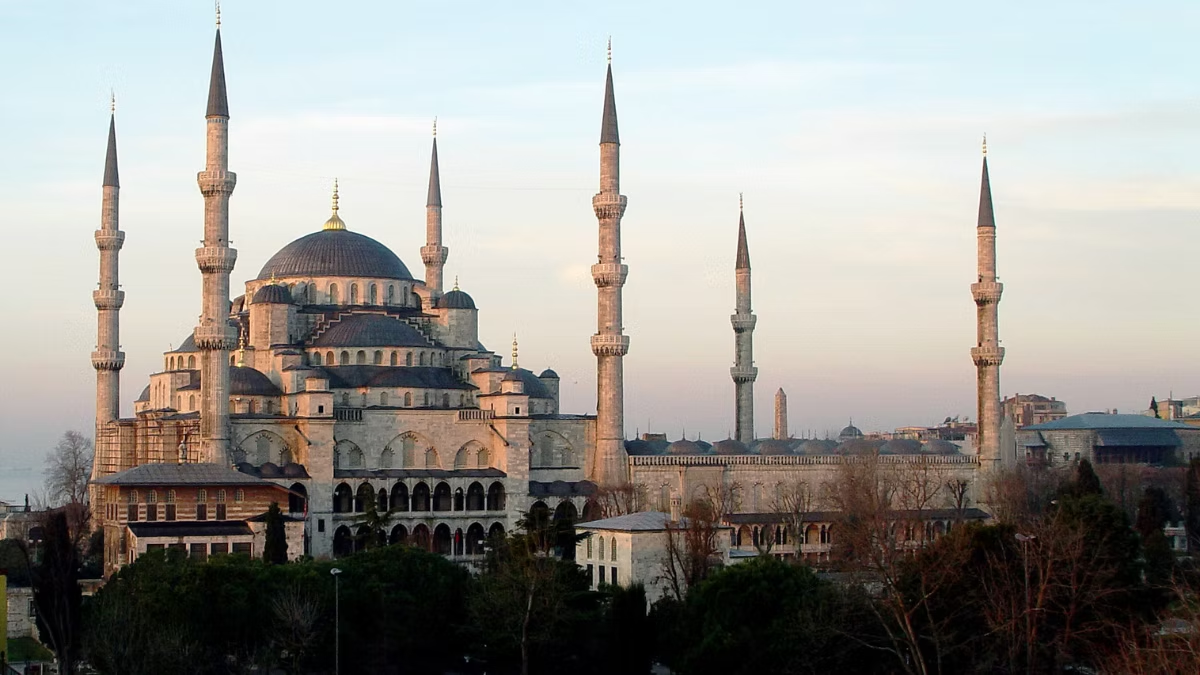
The Blue Mosque (officially the Sultan Ahmed Mosque) was commissioned by Sultan Ahmed I in 1609 and completed in 1617. Ahmed was 19 years old when construction began, and he chose to fund the mosque from the imperial treasury rather than war spoils — an unprecedented and controversial decision. He built it directly opposite Hagia Sophia in a deliberate act of Ottoman assertion, and died at age 27 just months after its opening. It has functioned as an active mosque ever since.
The story of the Blue Mosque is inseparable from the story of the man who built it. Sultan Ahmed I was 13 years old when he inherited the Ottoman throne in 1603 — the fourteenth sultan of an empire that had ruled from the Danube to the Euphrates, from Algiers to Baghdad, for nearly three centuries. But the empire he inherited was not the empire at its height. The great age of Suleiman the Magnificent was two generations past. The wars with Persia and the Habsburg Empire had been costly and inconclusive. The treasury was strained. And Ahmed I had done something that previous Ottoman sultans had never done: he had not won a single military victory from which to fund the grand architectural gesture that tradition demanded.
His response to that situation — building the grandest mosque Istanbul had seen in a generation, paid for with money he could not really spare, planted directly in front of the structure it was meant to surpass — is one of the most interesting acts of political and religious architecture in history.
The Site: Three Thousand Years of History Beneath the Mosque
The Blue Mosque stands on one of the most historically layered sites in the world. Before the mosque, the site was occupied by the Great Palace of Constantinople — the administrative and residential centre of the Byzantine Empire for nearly a thousand years. Before that, it bordered the Hippodrome of Constantinople, the chariot-racing circuit built by Roman Emperor Septimius Severus in 203 AD and expanded by Constantine the Great. When Sultan Ahmed I began construction in 1609, excavations uncovered ancient seats from the Hippodrome bleachers beneath what would become the mosque’s courtyard.
The Hippodrome — now the open square directly in front of the Blue Mosque, known as At Meydanı — was the epicentre of public life in Byzantine Constantinople for over a thousand years. It held up to 100,000 spectators at chariot races and was also the site of political celebrations, imperial processions, and, on one infamous occasion in 532 AD, the Nika Riots in which an estimated 30,000 people died following a chariot-racing dispute that escalated into a full revolt against Emperor Justinian.
The Great Palace — the sprawling complex of halls, churches, reception rooms, and gardens that served as the seat of Byzantine imperial power — occupied the land where the Blue Mosque now stands. By the time the Ottomans captured Constantinople in 1453, the palace was already in advanced decay. The Ottomans built their new palace at Topkapi, and the old Byzantine palace site was occupied by various smaller structures over the following century and a half, until Ahmed I began demolishing them to clear ground for his mosque in 1609.
Sultan Ahmed I: The Man Who Built the Mosque
Sultan Ahmed I ascended to the Ottoman throne in 1603, at the age of 13. He reigned during a period of military strain: the Ottoman-Habsburg War (known as the Long Turkish War or the Fifteen Years’ War) had ended in 1606 with the Peace of Zsitvatorok — a treaty widely perceived as a humiliation, the first in Ottoman history in which the Habsburgs were treated as equals rather than as tributaries. Simultaneously, war with Safavid Persia was ongoing and financially draining.
In Ottoman tradition, an imperial mosque was built from the proceeds of military conquest — the physical expression of God’s favour for a victorious sultan. Ahmed I had no conquests. He had no spoils. Yet he was acutely aware that no sultan had built an imperial mosque since Selim II (died 1574), and that both of his immediate predecessors — Murad III and Mehmed III — had failed to leave such a monument. The absence of a great mosque was felt as a gap in his legacy, and Ahmed I was determined to fill it.
His solution was to use funds from the imperial treasury — the public purse rather than war plunder. This was unprecedented and provoked immediate objection from the ulema, the body of Islamic scholars and jurists, who argued that building a mosque should follow victory, not precede it, and that taxing an already-strained population to fund imperial vanity was contrary to Islamic principles. Ahmed I pressed ahead regardless.
He broke ground personally in 1609, reportedly working as a labourer on the first day of construction — carrying soil in a wheelbarrow to signal his personal devotion to the project. He was 19 years old.
Construction: 1609 to 1617
Construction of the Blue Mosque began on 3 January 1609 and the main structure was completed in 1616. The mosque was officially opened for worship on 9 June 1617. The project took approximately seven years and five months and involved thousands of skilled craftsmen, labourers, quarry workers, tile painters, calligraphers, and carpenters. Sultan Ahmed I visited the construction site regularly and was closely involved in design decisions throughout the process.
The architect Sedefkâr Mehmed Ağa was appointed from the beginning. His design — a response both to the classical Ottoman mosque tradition established by Mimar Sinan and to the challenging visual presence of Hagia Sophia directly opposite — took the Şehzade Mosque as its structural model but scaled up the proportions and added unprecedented lavishness in the decoration.
The Iznik tile commission alone was an extraordinary undertaking. Ahmed I so prized these ceramic tiles that in 1613 he issued a decree forbidding the İznik workshops from producing tiles for any other customer until his mosque’s commission was complete. This monopoly on the finest tile production of the era gave the Blue Mosque its incomparable interior but effectively exhausted the İznik workshops — the industry never fully recovered to the same quality level after the commission concluded.
The six minarets provoked the controversy described in our architecture guide. Ahmed I resolved the religious objection by funding a seventh minaret for the Grand Mosque in Mecca, restoring Mecca’s supremacy in minaret count while allowing Istanbul’s new mosque to retain its six.
The construction cost was estimated at over 180 million akçes — an enormous sum that represented a significant strain on the already pressured Ottoman treasury. Critics within the empire questioned whether the expense was justified, particularly given the ongoing costs of warfare with Persia.
The Death of Sultan Ahmed I
Sultan Ahmed I died on 22 November 1617, at the age of 27 — barely six months after his mosque opened for worship on 9 June 1617. He had reigned for 14 years and, whatever the critics of his treasury-funded mosque argued, he had created a building that would outlast every empire that succeeded his own.
Ahmed I requested to be buried beside his mosque — a wish that was granted. His mausoleum (türbe) stands immediately to the northeast of the mosque, in a garden facing Sultanahmet Square. It was begun in 1619, after his death, and completed during the reign of his son Osman II. Unlike most Ottoman mausoleums, which traditionally have an octagonal form, Ahmed’s tomb has a square floor plan covered by a dome, giving it the appearance of a small mosque in its own right. His wife Kösem Sultan and several of his sons are also buried within the complex.
Subsequent History: Ottoman and Republican Eras
After its completion in 1617, the Blue Mosque functioned as the principal imperial mosque of Istanbul — the site where Ottoman sultans came to pray on Fridays and on religious occasions. This role gave it a political as well as religious significance: it was the mosque most closely associated with Ottoman imperial power and legitimacy.
The mosque suffered several significant fires over the centuries. The most damaging occurred in 1912, when the imperial pavilion (the sultan’s private entrance structure on the exterior) was partially destroyed. It was subsequently restored, though architectural historians have noted that the restored pavilion sits awkwardly within the overall composition — evidence of the limits of restoration versus original construction.
The Ottoman Empire collapsed in 1922 following World War One and the subsequent Turkish War of Independence. The Republic of Turkey was proclaimed in 1923 under Mustafa Kemal Atatürk. This transition had significant implications for Istanbul’s religious buildings: Hagia Sophia was converted from a mosque into a secular museum in 1934 as part of Atatürk’s secularisation programme. The Blue Mosque, however, was never converted — it continued to function as an active mosque throughout the Republican period, making it one of the few major Ottoman imperial mosques to have maintained continuous active religious use without interruption.
The 20th Century and Tourism
The Blue Mosque was listed as part of the UNESCO World Heritage Site “Historic Areas of Istanbul” in 1985, recognising the Sultanahmet district — including the mosque, Hagia Sophia, Topkapi Palace, and the Hippodrome — as one of the most significant historical urban concentrations in the world.
Throughout the 20th century, the mosque became increasingly central to Istanbul’s identity as a tourist destination. Today it receives approximately 4.5 million visitors annually, making it consistently one of the most visited monuments in Turkey and in the entire Islamic world. Unlike most major tourist attractions, it has maintained free entry throughout — a reflection of its continued status as an active place of worship rather than a museum.
The 2023 Restoration
The most extensive restoration of the Blue Mosque in the modern era was completed in 2023. The project ran for approximately five years and addressed structural, decorative, and infrastructural elements of the building:
- The calligraphic inscriptions on the central dome were cleaned and conserved using a 38-metre internal scaffolding structure
- Structural issues within the domes were repaired and lead roof coverings were renewed
- Three of the six minarets were fully dismantled — each stone numbered, restored individually, and reassembled in its original position
- All inner and outer window shutters were replaced
- The courtyard flooring was levelled and repaired to correct subsidence and deformation
- Underground drainage channels were redesigned
The mosque remained closed to visitors for only approximately five months during this period — an impressive logistical achievement for a restoration of this scale. The mosque reopened fully to visitors in April 2023 and has operated normally since, with all previously accessible areas remaining open.
The Blue Mosque Today
The Sultan Ahmed Mosque in 2025 is simultaneously one of the most visited tourist attractions in Europe and an active place of worship for Muslims in Istanbul and from across the world. Five daily prayers are called from its minarets, Friday Jumu’ah congregations bring thousands of worshippers, and the mosque maintains the full institutional structure of Islamic worship that has characterised it since 1617.
For the non-Muslim visitor, entry is free, respectful dress is required, and the five daily prayer closures create the rhythm of the visiting day. The experience of entering the prayer hall — whatever one’s own beliefs — is shaped by a building designed with extraordinary care to create a specific feeling: a sense of being enclosed within something vast, luminous, and carefully ordered, where every surface has been considered as a contribution to a unified spiritual atmosphere.
That atmosphere was the intention of a 19-year-old sultan who built it to outlast his own military failures. It has done rather more than that.
Blue Mosque History Timeline
| Year | Event |
|---|---|
| 203 AD | Hippodrome of Constantinople built by Septimius Severus |
| 330 AD | Constantine the Great expands the Hippodrome; Great Palace established nearby |
| 537 AD | Hagia Sophia completed across the square |
| 1453 | Ottoman conquest of Constantinople; Hagia Sophia converted to mosque |
| 1603 | Sultan Ahmed I ascends the throne aged 13 |
| 1606 | Peace of Zsitvatorok ends the Fifteen Years’ War |
| 1609 | Construction of the Blue Mosque begins (3 January) |
| 1613 | Ahmed I bans İznik tile production for all other customers |
| 1616 | Main structure of the mosque completed |
| 1617 | Mosque officially opens (9 June); Ahmed I dies (22 November) |
| 1619 | Sultan Ahmed I’s mausoleum begun |
| 1826 | Imperial pavilion used as headquarters during Janissary Revolt suppression |
| 1912 | Fire damages the imperial pavilion; subsequent restoration |
| 1934 | Hagia Sophia converted to museum under Atatürk |
| 1985 | Blue Mosque included in UNESCO World Heritage Site “Historic Areas of Istanbul” |
| 2018–2023 | Major restoration project |
| April 2023 | Full reopening after restoration |
Frequently Asked Questions
Why was the Blue Mosque built?
Sultan Ahmed I commissioned the mosque in 1609 primarily as an act of religious devotion and political statement. Following military defeats against Persia and the Habsburg Empire, and the perception that the Ottoman Empire was declining in power, Ahmed I wanted to demonstrate Ottoman piety and ambition by building the grandest mosque in Istanbul since the age of Suleiman the Magnificent. He also reportedly sought to atone to God for his sins as a young man. The mosque’s direct positioning opposite Hagia Sophia was a deliberate assertion of Ottoman and Islamic primacy over the Byzantine heritage.
How old is the Blue Mosque?
The Blue Mosque was completed in 1616 and opened for worship in 1617, making it over 400 years old. Construction began in 1609.
Who is buried in the Blue Mosque?
Sultan Ahmed I, the mosque’s patron and namesake, is buried in a mausoleum (türbe) immediately to the northeast of the mosque in a garden facing Sultanahmet Square. His wife Kösem Sultan and several of his sons are also buried in the complex.
Is the Blue Mosque a UNESCO World Heritage Site?
Yes. The Blue Mosque is part of the “Historic Areas of Istanbul” UNESCO World Heritage Site, designated in 1985. The designation covers the Sultanahmet district including the mosque, Hagia Sophia, Topkapi Palace, the Hippodrome of Constantinople, and the Byzantine city walls.
Was the Blue Mosque ever closed during the Republican era?
Unlike Hagia Sophia, which was converted to a secular museum in 1934, the Blue Mosque was never closed or converted. It has functioned as an active mosque continuously since its opening in 1617, including throughout the secularisation period of the early Turkish Republic. This makes it one of the longest continuously active imperial mosques in the Islamic world.
