
Attractions Near the Blue Mosque: Sultanahmet Day Plan
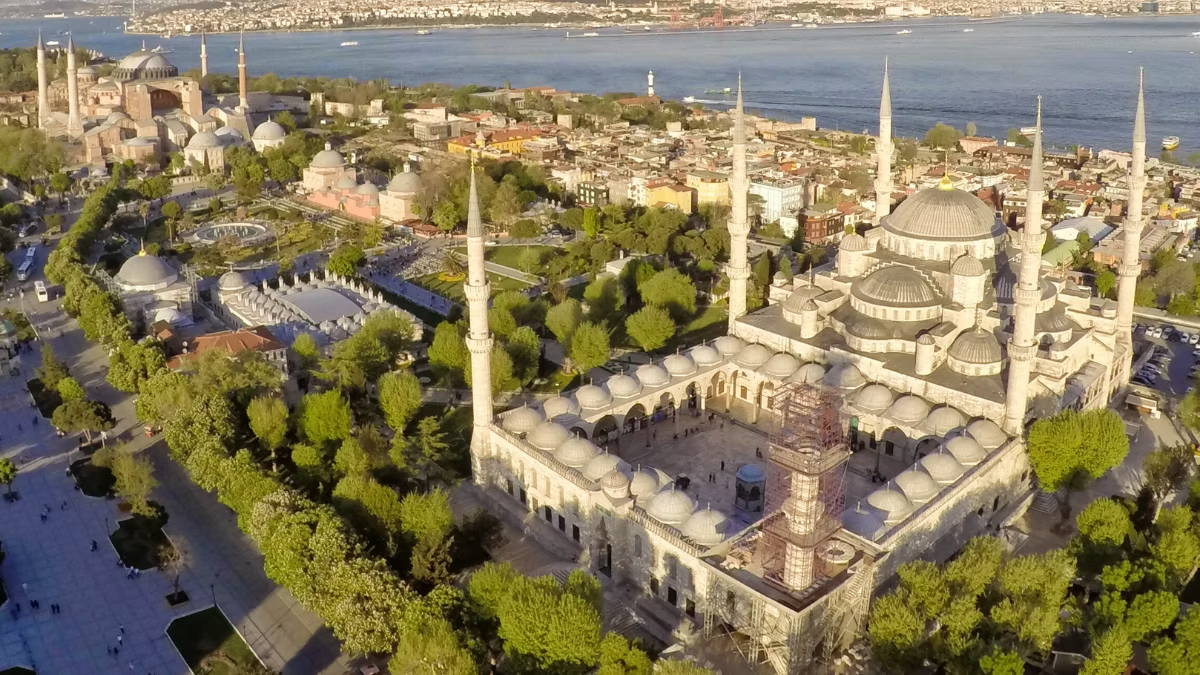
The Blue Mosque is surrounded by some of Istanbul’s greatest landmarks, all within easy walking distance. Hagia Sophia is a 2-minute walk across Sultanahmet Square, the Basilica Cistern is 4 minutes on foot, the Hippodrome of Constantinople is directly adjacent, Topkapi Palace is an 8-minute walk, and the Arasta Bazaar is immediately behind the mosque. A well-planned day in Sultanahmet can cover all of these without any transport.
The Blue Mosque does not stand alone. It sits at the heart of Sultanahmet — Istanbul’s historic peninsula and the former centre of both the Byzantine and Ottoman Empires. Within a radius of less than one kilometre, you will find more significant monuments per square metre than almost anywhere else on earth. The challenge for visitors is not finding things to do, but deciding what to prioritise and in what order to visit them without wasting time backtracking or getting caught by prayer closures.
This guide covers every major attraction within walking distance of the Blue Mosque, with honest time estimates, practical tips, and a recommended day itinerary that accounts for the mosque’s prayer closure windows.
Attractions at a Glance
| Attraction | Walking distance | Suggested time | Entry fee |
|---|---|---|---|
| Hagia Sophia | 2 min | 1–1.5 hours | Paid |
| Hippodrome of Constantinople | 2 min | 20–30 min | Free |
| Arasta Bazaar | 2 min | 20–30 min | Free |
| German Fountain | 2 min | 5 min | Free |
| Museum of Turkish & Islamic Arts | 3 min | 45–60 min | Paid |
| Basilica Cistern | 4 min | 45–60 min | Paid |
| Topkapi Palace | 8 min | 2.5–4 hours | Paid |
| Gülhane Park | 9 min | 20–30 min | Free |
| Grand Bazaar | 15 min | 1–2 hours | Free |
| Little Hagia Sophia | 7 min | 30 min | Free |
Hagia Sophia (Ayasofya)
Distance from Blue Mosque: 2-minute walk across Sultanahmet Square
Suggested time: 1–1.5 hours
Entry: Paid (tickets recommended in advance)
Hagia Sophia is the single most important site to combine with the Blue Mosque in a single visit. The two landmarks directly face each other across Sultanahmet Square — a 2-minute walk separates them. Built in 537 AD as a Byzantine cathedral and later converted to an Ottoman mosque, Hagia Sophia is the masterpiece that Sultan Ahmed I built the Blue Mosque to rival. Seeing both on the same day gives you an unparalleled sense of Istanbul’s layered history.
Originally constructed as the world’s largest cathedral under Emperor Justinian, Hagia Sophia served as a Greek Orthodox basilica for nearly 1,000 years before being converted to a mosque after the Ottoman conquest of Constantinople in 1453. Today it functions as an active mosque open to visitors. Its massive central dome — 31.24 metres in diameter — appears to float above the nave, and the surviving Byzantine mosaics in the upper galleries are among the finest in the world.
Hagia Sophia now has a ticketed entry system, and queues can be significant during peak season. Pre-booking is strongly recommended. The Hagia Sophia + Blue Mosque audio guide combo is one of the most efficient ways to cover both landmarks with expert context included.
Recommended visit order: Start at the Blue Mosque at 08:30 (before tour groups arrive), then cross to Hagia Sophia once you are done. Hagia Sophia’s queues are typically shorter in the morning.
The Hippodrome of Constantinople (At Meydanı)
Distance from Blue Mosque: 2-minute walk — directly in front of the mosque
Suggested time: 20–30 minutes
Entry: Free
The Hippodrome is the open plaza that stretches directly along the western facade of the Blue Mosque. It was the centre of Byzantine public life for nearly a thousand years — a chariot racing circuit that once held up to 100,000 spectators. Today the track is gone, but several of its ancient monuments survive in situ.
The three most significant are the Egyptian Obelisk (originally erected by Thutmose III in 1450 BC and brought to Constantinople in 390 AD), the Serpent Column (a bronze casting from Delphi dating to 479 BC), and the Constantine Column (a rough-hewn stone pillar from the 10th century). The German Fountain — an ornate Ottoman kiosk gifted by Kaiser Wilhelm II in 1898 — sits at the northern end.
The Hippodrome requires no ticket, no queuing, and no dress code. Walk through it at the start or end of your day, or use the wait during a Blue Mosque prayer closure productively — the views of the mosque’s exterior from the Hippodrome are among the best available.
The Basilica Cistern (Yerebatan Sarnıcı)
Distance from Blue Mosque: 4-minute walk
Suggested time: 45–60 minutes
Entry: Paid
The Basilica Cistern is a 6th-century underground Byzantine water reservoir located 4 minutes on foot from the Blue Mosque, beneath Sultanahmet Square. Built by Emperor Justinian in 532 AD to supply water to the Great Palace and later Topkapi Palace, it holds 80,000 cubic metres of water and is supported by 336 marble columns arranged in 12 rows. The cistern is best known for its two Medusa head column bases and its atmospheric underground lighting.
The Basilica Cistern is one of Istanbul’s most atmospheric spaces — cool, dim, and eerily beautiful. Wooden walkways guide visitors above the shallow water between the columns, and the Medusa heads (one inverted, one on its side, believed to have been placed this way to neutralise their mythological power) are a genuine highlight. The cistern was renovated and reimagined in recent years, with new sculptures and light installations added alongside the ancient structure.
Pre-booking a timed entry ticket is highly recommended during peak season, as the cistern has become one of Istanbul’s most popular attractions. The Blue Mosque & Basilica Cistern guided tour combines both sites with an expert guide and skip-the-line access.
Topkapi Palace (Topkapı Sarayı)
Distance from Blue Mosque: 8-minute walk
Suggested time: 2.5–4 hours
Entry: Paid (Harem requires separate ticket)
Topkapi Palace was the administrative centre of the Ottoman Empire for nearly 400 years, from the 1460s until the mid-19th century. The complex is enormous — a series of courtyards, pavilions, treasury rooms, imperial kitchens, and the famous Harem — perched on the headland above the Bosphorus with views across the sea to Asia.
The highlights are the Imperial Treasury (home to the Topkapi Dagger, the Spoonmaker’s Diamond, and rooms of extraordinary Ottoman jewellery), the Sacred Relics Room (containing items attributed to the Prophet Muhammad), and the Harem (an additional ticket but very much worth the cost — a labyrinth of tiled chambers, courtyards, and private apartments). Allow at minimum two and a half hours; history lovers frequently spend a full half-day.
Note that Topkapi Palace is closed on Tuesdays. Plan accordingly.
Arasta Bazaar
Distance from Blue Mosque: 2-minute walk — directly behind the mosque
Suggested time: 20–30 minutes
Entry: Free
The Arasta Bazaar is a covered Ottoman-era market running along the southern wall of the Blue Mosque. It is smaller, calmer, and more pleasant than the Grand Bazaar, with around 70 shops selling ceramics, textiles, Iznik tile reproductions, carpets, jewellery, and handicrafts. Because it sits directly beside one of Istanbul’s most visited mosques, the quality of goods is generally higher and the atmosphere less aggressive than at the bazaars further afield.
It is an ideal place to browse for 20–30 minutes between other sites, or to pick up a souvenir without the full Grand Bazaar experience. The Arasta also provides access to the Mosaic Museum (Büyük Saray Mozaikleri Müzesi), which houses Byzantine floor mosaics discovered beneath Sultanahmet in the 1950s.
The Museum of Turkish and Islamic Arts
Distance from Blue Mosque: 3-minute walk
Suggested time: 45–60 minutes
Entry: Paid
Located in the former palace of Ibrahim Pasha — Grand Vizier under Suleiman the Magnificent — the Museum of Turkish and Islamic Arts is one of Istanbul’s most overlooked gems. Its collection spans more than 40,000 objects across 1,300 years of Islamic civilisation, including some of the world’s finest antique carpets, Iznik ceramics, calligraphy, manuscripts, and ethnographic exhibits. The building itself, directly facing the Hippodrome, is a remarkable Ottoman palace in its own right.
If you have a particular interest in the decorative arts and architecture that inform everything you see at the Blue Mosque — the Iznik tiles, the calligraphy, the Ottoman design tradition — this museum provides the missing historical context.
Little Hagia Sophia (Küçük Ayasofya Camii)
Distance from Blue Mosque: 7-minute walk
Suggested time: 20–30 minutes
Entry: Free
Often overlooked in favour of its larger namesake, Little Hagia Sophia is a beautifully preserved 6th-century Byzantine church converted to a mosque during the Ottoman period. Built by Emperor Justinian between 527 and 536 AD — slightly before the great Hagia Sophia — it is considered the prototype for the larger building. The interior is intimate and serene, with original Byzantine columns, intricate stonework, and a tranquil courtyard garden. Entry is free and crowds are minimal.
Gülhane Park
Distance from Blue Mosque: 9-minute walk
Suggested time: 20–30 minutes
Entry: Free
Gülhane Park is a large public garden bordering the outer walls of Topkapi Palace. It was once the imperial gardens of the Ottoman sultans and remains one of the most pleasant green spaces in the old city. In spring, the park’s rose gardens and cherry trees are in full bloom — a popular subject for photographers. The park provides welcome relief between intense museum visits, with benches, tea gardens, and views down towards the Bosphorus.
The Grand Bazaar (Kapalıçarşı)
Distance from Blue Mosque: 15-minute walk along Divan Yolu Caddesi
Suggested time: 1–2 hours
Entry: Free
One of the world’s oldest and largest covered markets, the Grand Bazaar was established in 1461 and today contains more than 4,000 shops across 61 covered streets. It is an experience as much as a shopping destination — a labyrinth of gold jewellers, carpet dealers, leather goods, spice sellers, ceramics, and souvenir stalls, navigated by a river of visitors from across the world.
The Grand Bazaar is closed on Sundays. It is best visited either early in the morning (opening at 08:30) before the crowds peak, or in the late afternoon. Budget at least one hour; most visitors spend considerably longer. Combine it with the nearby Spice Bazaar (Egyptian Bazaar) at Eminönü for a full morning of market exploration.
Recommended Sultanahmet Day Itinerary
This itinerary is structured around the Blue Mosque’s prayer closure windows and the opening times of ticketed attractions. It assumes a mid-week visit (Tuesday–Thursday) in spring or autumn — the best time to visit.
08:30 — Arrive at the Blue Mosque as it opens. The prayer hall is quiet, the light is superb, and there are no tour groups yet. Allow 45–60 minutes inside.
09:30 — Walk 2 minutes to Hagia Sophia. Pre-booked tickets let you walk straight in. Allow 60–90 minutes to explore the ground floor and upper galleries.
11:00 — Walk back through Sultanahmet Square and visit the Hippodrome monuments (Egyptian Obelisk, Serpent Column). 20–30 minutes.
11:30 — Walk 4 minutes to the Basilica Cistern. Pre-booked entry is essential. Allow 45–60 minutes underground.
12:30 — Lunch. Several rooftop restaurants between the Cistern and Hagia Sophia offer views of the Blue Mosque’s domes. This also conveniently sidesteps the Dhuhr prayer closure (roughly 13:00–14:30) when the mosque is shut.
14:30 — Walk 8 minutes to Topkapi Palace (note: closed Tuesdays). Allow 2–3 hours for the courtyards, Treasury, and Harem.
17:00 — Return through Gülhane Park and down to the Arasta Bazaar behind the Blue Mosque for a browse. 20–30 minutes.
17:30 — Optional: Return to the Blue Mosque for the late afternoon visiting window. After the Asr prayer closure ends, the mosque is noticeably quieter and the interior light is particularly warm. This is the best time for photography inside the prayer hall.
Evening — Divan Yolu Caddesi towards the Grand Bazaar (open until 19:00 most days) or an evening in a rooftop restaurant with views of the illuminated Blue Mosque and Hagia Sophia.
Combo Tours Worth Considering
If you would rather not manage timings, queues, and logistics yourself, several guided tours cover multiple Sultanahmet attractions in a single morning or full day:
- Blue Mosque + Hagia Sophia Guided Tour with Tickets — covers both iconic mosques with an expert guide
- Blue Mosque + Hagia Sophia + Basilica Cistern Tour — the three most visited Sultanahmet sites in one itinerary
- Basilica Cistern + Hagia Sophia + Blue Mosque & Cruise — adds a Bosphorus cruise to the classic Sultanahmet combination
Several attractions in the area display their schedules on the official Blue Mosque website and partner sites — useful when planning your day.
Frequently Asked Questions
How many attractions can I visit near the Blue Mosque in one day?
Realistically, four to five attractions in a full day is comfortable without feeling rushed. The Blue Mosque, Hagia Sophia, the Basilica Cistern, the Hippodrome, and a walk through the Arasta Bazaar is a natural and very satisfying combination that fits within a single day.
Is Topkapi Palace worth visiting alongside the Blue Mosque?
Yes, but it requires a separate half-day. Topkapi is one of Istanbul’s finest museums and the historical complement to the Blue Mosque — both are expressions of Ottoman imperial ambition. If you have a full day, include it. If time is limited, prioritise Hagia Sophia and the Basilica Cistern as the most complementary pairing with the Blue Mosque.
Is Topkapi Palace open every day?
No — Topkapi Palace is closed on Tuesdays. Plan your visit on any other day of the week.
Do I need to book tickets for Sultanahmet attractions in advance?
For Hagia Sophia and the Basilica Cistern, advance booking is strongly recommended during peak season (June–August) to avoid long queues. The Blue Mosque is free and requires no ticket. Topkapi Palace tickets can usually be purchased on arrival outside peak season, but advance booking avoids queues.
What is the best restaurant near the Blue Mosque?
Several rooftop restaurants between the Basilica Cistern and Hagia Sophia offer views of the Blue Mosque’s domes and are excellent for a midday break. Restaurants along Divan Yolu Caddesi are also reliable for traditional Turkish cuisine at a range of price points.
